Democrats sweep Virginia's statewide offices, expand House majority
By Jahd Khalil, Margaret Barthel, Dean Mirshahi | 11/5/2025, 12:08 p.m.
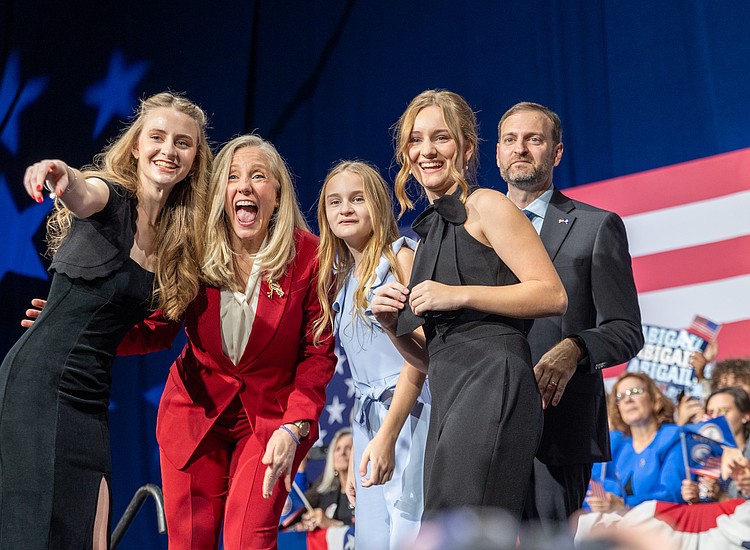
Abigail Spanberger will become the first woman to be Virginia's governor, according to The Associated Press.
Spanberger's victory comes alongside wins for the rest of the Democratic ticket: AP also said state Sen. Ghazala Hashmi (D–Chesterfield) won the lieutenant governor's race, and former Del. Jay Jones (D–Norfolk) won the attorney general's office. Speaker of the House Don Scott (D–Portsmouth) also appears to have grown his majority in the House of Delegates to one of the largest in decades.
The AP made the call in the governor's race just before 8 p.m. As of 12:47 a.m. Wednesday, Spanberger held a 57.5–42 lead with 97% of the state's votes counted. Election results are unofficial until certified by the state.
"We sent a message to every corner of the commonwealth, a message to our neighbors and our fellow Americans across the country. We sent a message to the whole world … that in 2025, Virginia chose pragmatism over partisanship," she said in her victory speech.
Spanberger was elected the US representative for the 7th Congressional District in 2018, reelected twice and chose not to run for reelection in 2024.
From 2019 to 2022, she represented a swath of Central Virginia stretching from Nottoway County to Culpeper County, but after redistricting in 2022, her district shifted north into the I-95 corridor, and she beat expectations in an election that saw Republicans retake control of the US House. She was formerly a CIA officer and a postal inspector before she returned to Henrico County, where she grew up.
Spanberger defeated Lt. Gov. Winsome Earle-Sears, who pitched her candidacy as a continuation of Republican Gov. Glenn Youngkin's administration — despite her role in day-to-day policymaking being unclear.
Earle-Sears addressed supporters at her election night party in Leesburg. The public concession speech occurred around 9:30 p.m., about an hour and a half after the race was called for Spanberger.
"I think I learn more in a loss than I ever do in a victory," Earle-Sears said. "It's either going to tear you apart, or it's going to build you. Well, I don't tear apart. I don't think we came up short. I think we tried very, very hard."
Earle-Sears said Spanberger didn't answer when she called Tuesday night, but that she left her a voicemail.
"I asked her to please consider all of us Virginians, that she will represent all of us, and not just some of us," she said. "And I wished her success. If she is successful, Virginia will be successful. I asked her to support policies that will unite us, that will not divide us."
In her remarks, Earle-Sears called for Spanberger to consider supporting a top priority for her as lieutenant governor and candidate: school choice. The Republican also turned her focus to religion, telling the crowd to pray for both Spanberger and Virginians.
"I don't consider this a loss, because remember, I've always said this," Earle-Sears said. "I'm a Christian first and a Republican second, and that's the way it always will be, because no political party has ever given their life for me."
Spanberger is on track to surpass former Vice President Kamala Harris's victory in Virginia in the 2024 presidential election. Harris won the commonwealth with 51.6% of the vote, though President Donald Trump ultimately returned to office for his second term.
She will enter office in January, as Virginia's economy is exposed to a number of challenges due to federal policy changes. The Republican-led Congress has passed legislation that removes billions of dollars in food assistance and health care subsidies, and a tax law that could lead to $2 billion less in federal tax collections.
Virginia's 322,000 federal workers are also under pressure, as a federal government shutdown is in its 35th day — tied for the longest shutdown ever, as of Tuesday — and the Virginia Employment Commission believes as many as 2,100 federal workers have applied for unemployment benefits because of a furlough (those claims need to be confirmed by the agency).
"Now that the campaign is over, the real work begins, because this was never about just winning an election. It was about what comes next," Spanberger said, promising to lower energy, housing and healthcare costs and "crack down on predatory pharmaceutical practices and surprise billing."
She also promised to protect abortion: "Health care decisions about contraception, fertility treatments and reproductive care will continue to be made between women and their doctors, not politicians."
Spanberger will also come into office with Democratic control of the legislature — a slim majority in the Virginia Senate, bolstered by Hashmi's ability to break ties, and a robust majority in the House of Delegates.
While mostly conciliatory, Spanberger also had some confrontational sections of her speech, though she did not mention Trump by name.
"To those across the Potomac who are attacking our jobs and our economy, I will not stand by silently while you attack Virginia's workers," she said. "As governor, my job will be to put Virginia first, full stop, and tonight, as the governor-elect, I call on Congress, Republicans and Democrats and our president, to make real progress on bringing this shutdown to an end."
In western Loudoun County, the federal shutdown was top of mind for Haley Morgan Wright, whose husband is a federal employee currently working without pay. She said she hopes Spanberger's emphasis on the contributions of civil servants continues after the election.
"[There's] this good chunk of people who are actually going into work because they are patriots, because they've opted to serve their country in this way and continue to do so even without money," she said. "That is, I don't feel like being highlighted as much as it should be."
Spanberger maintained her margin throughout the race, despite a texting scandal down-ballot and a controversial redistricting move by General Assembly Democrats. It's unclear if those issues, or the ongoing federal government shutdown, affected the race.
Spanberger raised just under $66 million in support as of Oct. 23, almost twice as much as Earle-Sears raised, according to statistics published by the Virginia Public Access Project.
At the polls on Tuesday, voters pointed to Spanberger's opposition to Washington and support for education as reasons they supported her.
Jennifer Kelsey-Backus was one of a steady stream of voters in Henrico. Kelsey-Backus also said education was a prime concern, but she was also voting for Spanberger because she's unhappy with the Trump administration.
"She has come out against the government shutdown and how it's affecting Virginians, not only in Richmond, but also Northern Virginia, which I grew up in," she said.
Kelsey-Backus was one of what appears to be tens of thousands of Virginians that voted for Spanberger and Hashmi, but not for Jones. She made the "tough" choice for incumbent Attorney General Jason Miyares, a Republican.
Jones' candidacy was beset by the October release of a series of violent text messages from 2022 in which he envisioned former Republican House Speaker Todd Gilbert being shot in the head. He also faced criticism over a reckless driving charge.
The Miyares campaign constantly reminded voters of these incidents in the final month before Election Day, which may help explain Jones' underperformance relative to Spanberger, though he also appears to have outperformed Harris' 2024 vote share.
This story originally appeared on VPM News.