Ending our 34-year run
2/12/2026, noon

The Richmond Free Press will cease publication this week, a bittersweet conclusion to a landmark publication that has served the Richmond community for 34 years.
This digital edition is the paper’s first and last online version. Last week’s print edition was the final printed Free Press.
“I don’t know that [Ray] thought that we would last this long after his death,” said Jean Boone, the Free Press publisher and founder’s wife, “but we kept plugging along and pushing and making a way out of no way.”
Raymond H. Boone Sr. founded the paper and served as editor and publisher, launching the first edition on Jan. 16, 1992. The Free Press continued to pursue its founding vision even after his death on June 3, 2014.
In the editorial pages of that first edition, Ray Sr. laid out his ambitious vision: “Richmond desperately needs a strong gust of fresh air to vigorously fan the expression of ideas about public policy and, in the process, to encourage wide-open, uninhibited debate. Simply put, the mission of the Richmond Free Press is to empower its readers.”
The Free Press followed in the tradition of Black newspapers in Virginia. Ray Sr. got his start in his hometown of Suffolk in the 1950s, handling writing for the “colored pages” of the Suffolk News-Herald.
He worked across multiple outlets for decades, including editing the Richmond Afro-American newspaper. He later became the paper’s vice president, overseeing national circulation while teaching at Howard University.
Boone’s experiences not only prepared him to create his own newspaper but also to identify mainstream news industry failings that were in need of balance, as he explained in a Voices of Freedom interview for Virginia Commonwealth University in 2003.
“Newspapers, to a large degree, ignored the principles of journalism, of being fair,” Ray Sr. said. “Instead, they promoted segregation, and they promoted what was popular, rather than honoring the First Amendment, which stands for giving free expression to all segments of the community.”
When he returned to Richmond in 1991, he created an alternative to this media environment, providing an avenue for underserved community perspectives, particularly Black Richmonders, while championing free expression, justice and equality.
The Free Press founder combined disciplined leadership with a willingness to challenge authority. Those who worked under him still hold his lessons in high regard.
“It was a [Marine] boot camp for journalists,” said Hazel Trice Edney, the first Free Press reporter, who worked with the paper for over eight years. “Mr. Boone was the best mentor any journalist could have.”
The Free Press and its mission was one shared throughout the Boone family, with Ray Sr. and Jean working side by side to handle operations. Their daughter Regina would later join the team as a photojournalist, while their son Ray Jr. served as vice president of new business development.
Wayne Dawkins, author of “Black Journalists: The NABJ Story,” said this family-owned structure linked the Free Press to a tradition of Black newspapers such as the Norfolk Journal and Guide and the Chicago Defender. He added that despite the rigors of producing a weekly free paper, the Free Press’ work and influence could be felt outside of Richmond.
“The Free Press did it well,” Dawkins said.
The newspaper encountered hostility from white-owned publications and some community members when it launched. Its editorials and coverage drew criticism and pushback.
Regina recalls threatening phone calls and vandalism of news boxes in response to the Free Press’ work. She views the strong reactions, even critical ones, as evidence of the trust the newspaper built with readers.
“Even when they didn’t agree with editorials or [coverage choices], they still were so curious and so devoted to picking us up and reading us,” Regina said, “and they felt comfortable enough to share their admiration or their disdain for something that was printed in the paper.”
The Richmond Free Press is ceasing publication at a time of upheaval across the news industry, and questions about what might come next remain.
Jean has promised she’s “not going anywhere,” despite recent health challenges and that the family will “do the best we can to travel the road that we find ourselves on.”
Edney said the paper’s closure does not diminish what it accomplished.
“The impact that the Free Press has made on justice in Virginia,” she said, “it resonates and reverberates to the extent that it has paid its dues, it has done its job.”
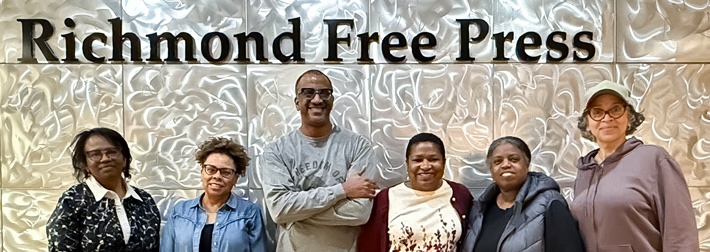
Staff members April Coleman, Vice President of production, writer Jennifer Robinson, Managing Editor Craig Belcher, former reporter Hazel Trice Edney, Vice President of administration Tracey Oliver and production assistant Joyce Jackson. (Sandra Sellars/Richmond Free Press)
_BsP8vHG.jpg) The final print edition of the Richmond Free Press, dated Feb. 6, in the paper’s newsroom. Raymond H. Boone Sr. founded the independent weekly newspaper in 1992 and served as editor and publisher until his death in 2014. The Free Press has been headquartered in the historic Imperial Building at Fifth and Franklin streets since 2001.
The final print edition of the Richmond Free Press, dated Feb. 6, in the paper’s newsroom. Raymond H. Boone Sr. founded the independent weekly newspaper in 1992 and served as editor and publisher until his death in 2014. The Free Press has been headquartered in the historic Imperial Building at Fifth and Franklin streets since 2001.