Abigail Spanberger sworn in as Virginia’s first woman governor
By Markus Schmidt | 1/17/2026, 4:15 p.m.
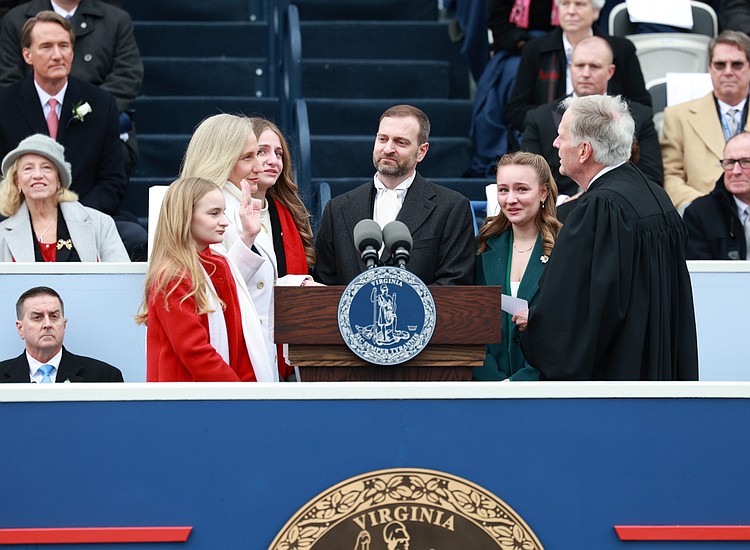
Abigail Spanberger was sworn in Saturday as Virginia’s 75th governor, making history as the first woman to hold the commonwealth’s highest office and pledging to lead with unity, affordability and pragmatic action amid deep national divisions and growing uncertainty coming out of Washington.
Within hours of taking the oath, Spanberger, 46, moved swiftly to define the priorities of her administration, signing a package of executive orders aimed at lowering costs for families, strengthening public education, responding to federal disruptions and reshaping the internal operations of state government — an early signal that her tenure will be focused on affordability and what she described as “delivering results.”
Standing on the steps of the Virginia state Capitol in Richmond, Spanberger framed the moment as both historic and forward-looking, calling the peaceful transfer of power “a cornerstone of our American democratic experiment” and a defining feature of American democracy.
“It is the honor of my life to stand before you and take the oath today,” Spanberger said, underscoring the gravity of the moment and her responsibility to all Virginians.
She reflected on the generations who expanded democracy in Virginia — particularly women who fought for the right to vote and hold office — saying she stood before those “who could only dream of a day like today.”
Spanberger was sworn in alongside fellow Democrats Ghazala Hashmi, who took the oath as lieutenant governor, becoming the first Muslim to win statewide office in the United States, and Jay Jones, who was sworn in as Virginia’s attorney general, becoming the commonwealth’s first Black attorney general.
The ceremony drew a cross section of Virginia’s political leadership, including all living former governors, from outgoing Republican Gov. Glenn Youngkin to L. Douglas Wilder, the nation’s first elected Black governor, who celebrated his 95th birthday Saturday and whom Spanberger recognized during the event.
Maryland Gov. Wes Moore and U.S. Rep. Adam Schiff, D-Calif., were also in attendance.
Spanberger thanked Youngkin and former first lady Suzanne Youngkin for their cooperation during the transition, as well as former Lt. Gov. Winsome Earle-Sears, former Attorney General Jason Miyares and members of the outgoing administration for their service. Earle-Sears and Miyares did not attend the ceremony.
Much of Spanberger’s inaugural address traced Virginia’s long democratic arc — from George Washington and Patrick Henry to the suffrage movement and the civil rights era — but she emphasized that the day was ultimately about the future Virginians will shape together.
Citing Patrick Henry’s warning that “United we stand, divided we fall,” Spanberger urged Virginians not to fracture into factions that threaten democratic institutions.
She said the work of perfecting democracy has never been finished but argued that Virginia’s history shows progress is possible when leaders and citizens confront challenges directly.
“This square has been the scene of remarkable dramas of equality and justice,” she said, referencing suffragists who pressed their cause at the Capitol, the delayed ratification of the 19th Amendment and the 1957 Pilgrimage of Prayer led by the Rev. Martin Luther King Jr.
She also invoked moments when Virginia leaders confronted division head-on, quoting former Gov. Linwood Holton’s call to move beyond partisan camps and to “act together,” and highlighting Wilder’s 1990 inauguration as another milestone that reshaped expectations of who could lead.
Throughout the address, Spanberger emphasized the meaning of Virginia as a commonwealth — a government designed to serve the common good — and framed unity as both a moral obligation and a practical necessity.
The urgency of that message was reflected in Spanberger’s first official acts as governor.
The series of executive orders she signed after the swearing-in were designed to confront rising costs, reinforce public education and prepare the state for potential disruptions tied to federal policy changes.
“Today, we are responding to the moment,” Spanberger said. “We are setting the tone for what Virginians can expect over the next four years: pragmatic leadership focused on lowering costs and delivering results.”
The first three executive orders focus on affordability, an issue she declared a centerpiece of her 2026 agenda during a December news conference.
One requires the governor’s secretaries and all executive branch agencies to submit reports within 90 days identifying immediate, actionable steps to reduce living expenses for Virginians, including housing, health care, energy, education, child care and grocery costs.
A second establishes an Interagency Health Financing Task Force within the Office of the Secretary of Health and Human Resources, charged with developing a unified financing strategy to reduce duplicative spending, maximize federal funding and strengthen Virginia’s long-term health care infrastructure.
The task force is directed to assess programs most vulnerable to federal policy changes, review oversight of managed care organizations and evaluate shared technology, licensing and procurement systems.
A third directive launches a comprehensive review of housing development regulations and permitting practices, with the goal of eliminating unnecessary requirements and reducing barriers to housing production. It also creates a Commission on Unlocking Housing Production to recommend legislative, regulatory and administrative changes to increase housing supply statewide.
Academic progress is the focus of a fourth executive order directing the Department of Education to strengthen literacy and math instruction, review accountability measures and expand access to advanced math coursework.
The directive calls for implementing recommendations from a 2025 JLARC report, advancing a next-generation assessment system and launching a statewide listening tour of educators, parents and students.
Other executive actions respond to external pressures, including federal workforce reductions, funding cuts, tariff impacts and immigration-related effects.
One order establishes an Economic Resiliency Task Force to coordinate the state’s response, including managing potential disruptions to Medicaid and SNAP, supporting displaced federal workers and expanding agricultural and forestry exports amid tariff uncertainty.
Additional orders initiate a review of the Board of Visitors appointment process for public colleges and universities; establish narrowly defined standby emergency authority for senior officials if the governor is unreachable; formally delegate operational authority to the governor’s chief of staff; and create a comprehensive equal opportunity and nondiscrimination policy across state government.
A 10th executive order rescinds Youngkin’s Executive Order 47, which required and encouraged state and local law enforcement agencies to divert resources toward enforcing federal civil immigration laws.
The directive redirects law enforcement to focus on core public safety responsibilities, including investigating crime, staffing local jails and engaging with communities.
The move aligns with a position Spanberger outlined during an interview with The Mercury in August, when she said she would move quickly as governor to end policies she argued pulled Virginia law enforcement away from their primary mission and strained limited resources.
In her inaugural address, Spanberger did not name President Donald Trump but referenced federal actions and rhetoric she said were unsettling Virginians.
“I know many of you are worried about the recklessness coming out of Washington,” she said, citing concerns over health care access, rising costs, attacks on public servants and policies she said betray American values.
She rooted her priorities in personal experience, describing her middle-class upbringing, her work as a federal law enforcement officer and her service as a CIA case officer focused on counterterrorism and nuclear proliferation.
She also spoke as a mother of three daughters, emphasizing the strain rising costs place on families and the difficulty of planning for the future amid uncertainty.
Her policy agenda centers on affordability, education, economic growth and public safety.
As she closed her address, Spanberger urged Virginians to consider how future generations will judge this moment.
“Choose to stand united. Choose to serve one another. Choose to act together,” she said. “As we continue forward, let us be united for Virginia’s future."
This story originally appeared on VirginiaMercury.com