Personality: Valerie Cassel Oliver
Spotlight on the Sydney and Frances Lewis Family Curator of Modern and Contemporary Art at the Virginia Museum of Fine Arts
1/22/2026, 6 p.m.
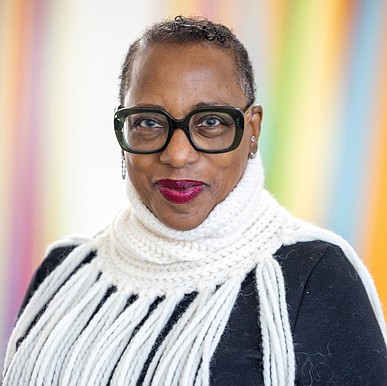
As a student in Houston, Valerie Cassel Oliver took field trips to what she felt were magical places — the city’s museums. Years later, as an award-winning curator, she fills those magical spaces to celebrate the history and culture of African Americans.
“My parents discouraged me from going into the arts,” Oliver said. “They wanted me to have a job that would allow me to support myself.”
Oliver earned a bachelor’s degree in communications from the University of Texas at Austin, but fate led her away from the path her parents envisioned. She discovered her flair for visual storytelling at the Black Arts Alliance in Austin, where she helped organize programs across a range of art forms.
“The Black Arts Alliance was a very small arts organization, but I realized I liked giving artists a voice,” she said.
While working at the Black Arts Alliance, Oliver met the chair of Howard University’s art department, who recognized her potential and encouraged her to pursue graduate studies there. During her master’s program, she immersed herself in art history, theology and anthropology. This interdisciplinary approach deepened her understanding of cultural contexts and storytelling in art and shaped her vision as a curator, presenting art as a dialogue that bridges history and cultural narratives.
“There was no language for what I wanted to do at that time,” she said. “I saw artists bring the world into their work, and I wanted the background to give me context.”
After completing her graduate studies, Oliver worked with the National Endowment for the Arts. She also embraced teaching and became the director of the visiting arts program at the School of the Art Institute of Chicago. The classroom became a space for her to work with art forms to inspire students.
In 2000, Oliver reached a turning point when she was invited to co-curate the prestigious Whitney Biennial, a major contemporary art exhibition organized by the Whitney Museum of American Art in New York City. The opportunity gave her a platform to make an impact on the art world.
“When I got the call, I was like that’s not my job,” Oliver said. “I had been teaching. It was the first time I thought about art in a visual space since the Black Arts Alliance in Austin.”
It wasn’t long before Oliver was offered a curator position at the Contemporary Arts Museum Houston — one of the magical spaces she visited as a student. There, she organized numerous exhibitions, garnering nationwide acclaim.
Oliver is now the Sidney and Frances Lewis Family Curator of Modern and Contemporary Art at the Virginia Museum of Fine Arts. Since her arrival at the VMFA in 2017, her exhibitions have been recognized for their ambition, historical resonance and cultural significance.
“Culture can be used for good or bad,” Oliver noted. “We should be in positions of power where we control that.”
What are some of the exhibits you’ve been responsible for at the VMFA?
My debut at the VMFA was “Howardena Pindell: What Remains To Be Seen,” which I co-organized with Naomi Beckwith in 2018. In 2021, I opened “The Dirty South: Contemporary Art, Material Culture, and the Sonic Impulse,” which toured nationally. In 2023, I organized the “Dawoud Bey: Elegy” exhibit, which examines the artist’s preoccupation with histories of place. The work includes commissioned photographs of Richmond’s Historic Slave Trail exhibited with previous bodies of work created in Louisiana and Ohio. It’s now on tour at the New Orleans Museum of Art until early 2026. I’ve also done the “Ted Joans: Drawings from Africa” that featured the complete portfolio of Joans’ drawings from 1956; “Theaster Gates: Wonder Working Power”; and “Robert Rauschenberg: Cardbirds.”
“Giants: Art from the Dean Collection of Swizz Beatz and Alicia Keys” is the latest that you’ve had a hand in.
Alicia Keys and her husband, Swizz Beatz, champion “artists supporting artists” through their renowned collection, featuring the works of nearly 40 diverse Black, African and diasporic creators like Jean-Michel Basquiat, Gordon Parks, Barkley L. Hendricks, Nina Simone, Kehinde Wiley, Amy Sherald, Nick Cave, Lorna Simpson and Derrick Adams. It’s running until March 1 and features roughly 130 works, including paintings, installations, photos and sculptures.
How did it come to the VMFA?
It’s a process because of the calendar. There’s a balance between internal exhibits and bringing in those that align with our mission. We want it to align with our mission. Almost all the artists in “Giants” are in the permanent collection or are on view. We knew our audience would be excited. I’m proud of what they’ve amassed and presented. It’s extraordinary.
Where do you live now?
In the near West End.
What do you think of Richmond?
Richmond has a nice vibe. It’s beautiful. I had never lived in a place with such a strong consciousness of its history and a desire to keep it alive. It’s an interesting place and perspective to work from. We need to interrogate this history. We’re tired of the narrative that has emboldened some. I’ve felt a transformation in the nine years I’ve been here — in the way people move. The signs and symbols need to come down.
What do you think about the Richmond arts scene?
It’s burgeoning. I came to Richmond because I was invited to speak at Virginia Commonwealth University, which has a dynamic art department. Back then, there was a small arts scene, and there weren’t many African Americans in it. I turned around, and it was there! It’s starting to explode.
Do you create any art?
No. I feel that my career as a curator is my creative outlet. There’s a whole team, but laying out a vision for them is where my creativity lies.
What artists’ work have you collected?
Once you move into a collecting institution, there are ethical concerns. I was able to acquire works by many artists through my job and in Chicago. It’s 26 years, but I have been able to acquire pieces by William Cordova, Carrie Mae Weems, James Van Der Zee and many others.
What advice do you have for collectors?
Buy it because you love it and you want to live with it. The art world is so fickle and subjective. I wouldn’t buy for investment purposes. Determine what you can afford. Align with your vision. Try to find emerging to mid-career artists who are still affordable.
Tell us about your family.
I have 10 siblings, and my son will be 15 soon.
What do you do in your downtime?
I love to read, although I don’t do enough. I love to shop. It’s the finest sport I know. I love vintage design, furniture, jewelry, books and clothes.
What’s your favorite hobby?
I love the idea of recreating photo albums. I do one every year for my son, which serves as a record of each year of his life.
What’s next?
I want to visit Mary Lovelace O’Neal, an abstract painter from San Francisco now living in Mexico. We’re interested because there’s been a recent focus on her earlier work. I’m doing a major retrospective of Alvin D. Loving focused on his legacy. Also, I’m going to be very intentional about self-care.